
Understanding Your Bill – Useful Terms
Rate Class
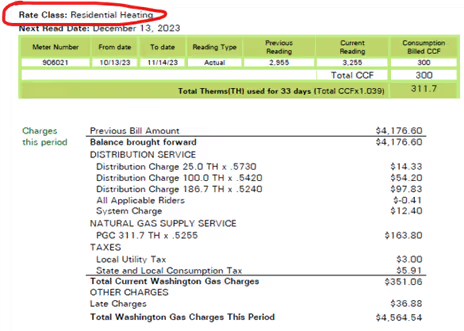
Your rate class will be based on the purpose of the property use (Residential/Commercial/Group Metered) and the gas service utilization (To heat/cool the property or for other purposes such as fireplace/water heater/dryer/stove). Distribution rates and other charges are dependent on your rate class.
Residential Service - Service to customers for residential purposes by individual meter in a single-family dwelling, individual apartment, up to three families served by a single meter (one customer) in a multiple family dwelling.
- Heating and/or Cooling - Where gas is used to supply the principal space heating and/or air-cooling requirements of a dwelling, including any other residential uses. Where gas is used in conjunction with service to commercial or industrial premises, the service shall be classified Commercial and Industrial service.
- Non-Heating and Non-Cooling - Where gas is not used to supply the principal space heating and/or air-cooling requirements but is used for any other residential purposes.
Commercial Service - This category shall include service to commercial and/or industrial customers, including schools, churches, embassies, rest homes, boarding houses, rooming houses, etc. supplied through one meter or a battery of meters.
- Heating and/or Cooling - Where gas is used to supply the principal space heating and/or air-cooling requirements, including other commercial and/or industrial uses
- Non-Heating and Non-Cooling - Where gas is not used to supply the principal space heating and/or air-cooling requirements but is used for any other commercial and industrial purposes. Where gas for a commercial and industrial purpose is used in conjunction with service to residential premises, the service shall be classified Commercial and Industrial Service.
Group Metered Apartments - Service applicable to any multiple-dwelling building or project comprised of four or more dwelling units (apartments) supplied through one meter or a battery of meters.
- Heating and/or Cooling - Where gas is used to supply the principal space heating and/or air-cooling requirements of the dwellings, including any other uses.
- Non-Heating and Non-Cooling - Where gas is not used to supply the principal space heating and/or air-cooling requirements but is used for any other purposes.
The Rate Class is located on the top left of the second page.
Meter Reading
To read a meter with dials, please do the following:
- Starting with the left dial on the row of four (see diagram below), locate the dial hand and record the last number it has passed (taking note of the direction of the arrow on the dial).
- If the hand is between two numbers, record the lower number. If one hand is directly over a number, record that number. Continuing to the right, follow the same procedure for the three remaining dials.

Note: Actual readings will be attempted monthly, if an actual read could not be obtained, an estimated read based on historical usage and weather conditions will be utilized.
CCF: A unit of measurement for gas used. One CCF = 100 cubic feet.
How calculated: Current Reading – Previous Reading = Consumption Billed CCF

Therm (TH): For billing purposes, your natural gas usage is expressed in therms. A therm is a measure of the heat energy in natural gas and is approximately equal to the heat content in 100 cubic feet of natural gas, or a Centum Cubic Feet (CCF). Your meter reading (expressed in CCF of natural gas) and an energy content conversion factor determine the total number of therms you use.
How calculated: CCF x Therm Conversion rate = Therm

Bill Charges
Bill is composed of three sections:
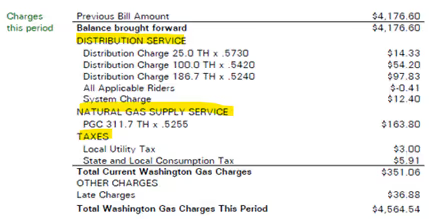
- Distribution Service - This covers the cost of transporting the natural gas through the Washington Gas system to your meter.
- Natural Gas Supply Service - This relates to the purchase and provision of the natural gas supply or commodity.
- Taxes - Imposed by your local jurisdiction, taxes are collected by Washington Gas and remitted to the appropriate taxing authorities.
Distribution Service Charges
Distribution Charge: The "distribution charge" is the amount the Company charges for delivering each therm of purchased gas consumed by the customer. Such charge is a measure of the costs of the Company to provide, maintain and operate a system of underground piping to distribute purchased gas to the service piping located on the customer's property.
How calculated: Therm usage, categorized by different rates, with the first covering up to 25 Therms, the second between 25 and 125 Therms, and the last for usage greater than 125 Therms x distribution rate
System Charge: Covers certain other costs of providing your service, including depreciation of equipment, taxes, maintenance and repair of customer lines, and expenses such as reading and billing. The "system charge" is a measure of the costs of the Company's facilities and other costs that do not vary with the amount of gas the customer consumes.
How calculated: Fixed monthly charge per rate type
All Applicable Riders: Since September 2011, the Virginia State Corporation Commission (SCC) requires Washington Gas to combine all SCC-approved billing adjustments that are applied to the distribution charge into a single line item, “All Applicable Riders,” on all Virginia customer bills Below are a listing of billing adjustment components:
- ESM(Earnings Sharing Mechanism): The Distribution Charges specified in this rate schedule shall be subject to an adjustment per therm, included in the item “All Applicable Riders” on customers’ bills, as set forth in General Service Provision No. 29.
- CRA(CARE Ratemaking Adjustment): Customers billed under this rate schedule shall have a CARE Ratemaking Adjustment (CRA) applied to their bill, included in the item “All Applicable Riders”, on a monthly basis in accordance with Section 30 of the General Service Provision.
- CCA(CARE Cost Adjustment): The charges specified in this rate schedule shall be subject to an adjustment per therm, included in the item “All Applicable Riders” on customers’ bills, as set forth in General Service Provision No. 31.
- Performance-Based Rate Recovery: The Distribution Charges specified in this rate schedule shall be subject to an adjustment per therm, included in the item “All Applicable Riders” on customers’ bills, as set forth in General Service Provision No. 33.
- Save Rider: The Distribution Charges specified in this rate schedule shall be subject to an adjustment per therm, included in the item “All Applicable Riders” on customers’ bills, as set forth in General Service Provision No. 34.
- RSM(Risk Sharing Mechanism): The Distribution Charges specified in this rate schedule shall be subject to an adjustment per therm, and included in the item “All Applicable Riders,” on customers’ bills, in accordance with Section 21 of the General Service Provision.
How calculated: Therm x All Applicable Rider Rate
Natural Gas Supply Service Charges
PGC (Purchased Gas Charge): The "purchased gas charge" is the amount the Company charges for each therm of gas consumed by the customer. The gas consumed under this schedule shall be billed an amount per therm representing the average unit cost of purchased gas in accordance with Section 16 of the General Service Provisions. This Purchased Gas Charge (PGC) includes the cost to purchase the natural gas supply, plus the expense of transporting it through the interstate natural gas pipeline system. By regulation, Washington Gas must charge customers what it pays for the natural gas supply they use and cannot profit by increasing the cost of the natural gas supply it sells.
Note: If you buy gas from an energy supply company, the price should be specified in your contract with the supplier.
How calculated: Therm x PGC Rate
Tax Charges
Local Utility Tax: Imposed by your local jurisdiction, taxes are collected by Washington Gas and remitted to the appropriate taxing authorities.
How calculated: Most are setup with a jurisdiction base charge + (CCF x a jurisdiction rate), the tax usually has a dollar maximum per month
State and Local Consumption Tax: a utility consumption tax is imposed on the consumers of natural gas by the Virginia Public Service Taxation Division
How calculated: CCF(maximum defined by rate class) x Tax Rate
WNA (Weather Normalization Adjustment): Is a separate line item on an annual basis in accordance with Section 28 of the General Service Provision. The WNA shall be charged or credited on each applicable customer bill once each year in the billing month of August and, as necessary, in subsequent billing months of September and October. August bills will be limited to three percent (3%) of the actual October – May distribution charge revenue for the firm service rate class. Any remaining non-gas revenue surcharge amount will be reflected on bills rendered in the subsequent month, as necessary, subject to the same limitation. Any remaining balance will be applied in the third month. The WNA shall appear as a specific dollar charge or credit set out as a separate line item on the customer bill.
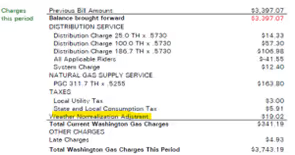
How calculated: Adjustment Factor per therm x (Actual usage for the WNA period of October through May - (Individual Customer’s Base Usage x 8)).
- Individual Customer’s Base Usage is defined as each customer’s average usage for July and August of the test year in the most current rate case. If in any given month during the WNA period the customer’s actual usage is less than the Individual Customer’s Base Usage, then that month’s actual usage will be considered base usage for that month.
- Adjustment Factor per therm = Total Revenue Adjustment / (Total Actual Therms - (Base Usage as shown in General Service Provision 28 x Total number of bills))
- Total Revenue Adjustment = Volume Adjustment x Weighted average cost rate per therm by class as shown General Service Provision 28
- Volume Adjustment = (Normal HDD’s as shown in General Service Provision 28 - actual HDD’s) x (Variation per HDD by class as shown in General Service Provision 28 x (Total number of bills for the WNA period / 8)
- Total Revenue Adjustment = Volume Adjustment x Weighted average cost rate per therm by class as shown General Service Provision 28
Other Charges
Late Charges: Charge applied to arrearage invoice balances not paid by the due date. No late payment charge shall be levied on any amounts, including deferred payment installments, paid by the due date, or on amounts in dispute before the Commission.
How calculated: If bills are not paid within twenty days after rendition, a late payment charge will be added equal to one percent of the unpaid bill and at the end of each nominal thirty day billing interval thereafter, an additional charge will be made equal to one and one-half percent of any total amount which remains unpaid at that time.